Consumer Unit Upgrades & Fuse Box Replacement in East London
Upgrade your home’s electrical protection with a professionally installed modern consumer unit. ZJ Electrical Services provides consumer unit replacements across Leyton, Walthamstow and East London, with every installation carefully assessed, tested and certified by a NICEIC Approved Contractor.
NICEIC Approved Contractor • 14+ Years’ Electrical Experience • Fully Tested & Certified
What’s Included in a Consumer Unit Replacement?
Important: An EICR must be completed before the consumer unit replacement is carried out. Any C1 or C2 defects identified on the report, other than those that will be resolved by the consumer unit replacement itself, must be rectified before installation. If an EICR has not yet been completed, or other required remedial work is outstanding, ZJ Electrical Services can arrange this separately at additional cost.
- Removal of the existing consumer unit and installation of a new metal consumer unit – correctly sized for the property and the number of circuits.
- New meter tails included – appropriately sized consumer-side meter tails are installed between the meter or isolator and the new consumer unit, subject to the existing metering arrangement.
- Individual RCBO protection – protective devices selected to suit the installation, helping prevent a fault on one circuit from unnecessarily affecting other circuits.
- Surge Protection Device (SPD) – included where required by the electrical design and current BS 7671 requirements.
- AFDD protection where required – in some cases, Arc Fault Detection Devices (AFDDs) are required. Where applicable, these will be included as part of the new consumer unit installation.
- Spare ways for future circuits – where practical, we allow additional space for future electrical requirements such as EV chargers, heat pumps and dedicated air-conditioning supplies rather than filling the consumer unit to capacity from day one.
- Optional consumer isolator – where suitable and not already installed, a separate double-pole isolator can be arranged to make future electrical work and consumer unit isolation easier.
- Neat cable termination and clear circuit identification – circuits are professionally organised and labelled for easier identification and future maintenance.
- Inspection and testing of the new consumer unit installation – completed after installation to verify the new work and protective devices operate correctly.
- Certification & Building Regulations paperwork – following satisfactory completion and testing, you will receive an Electrical Installation Certificate (EIC). We also notify the consumer unit replacement through our NICEIC registration, and a Building Regulations Compliance Certificate is issued for the completed work.
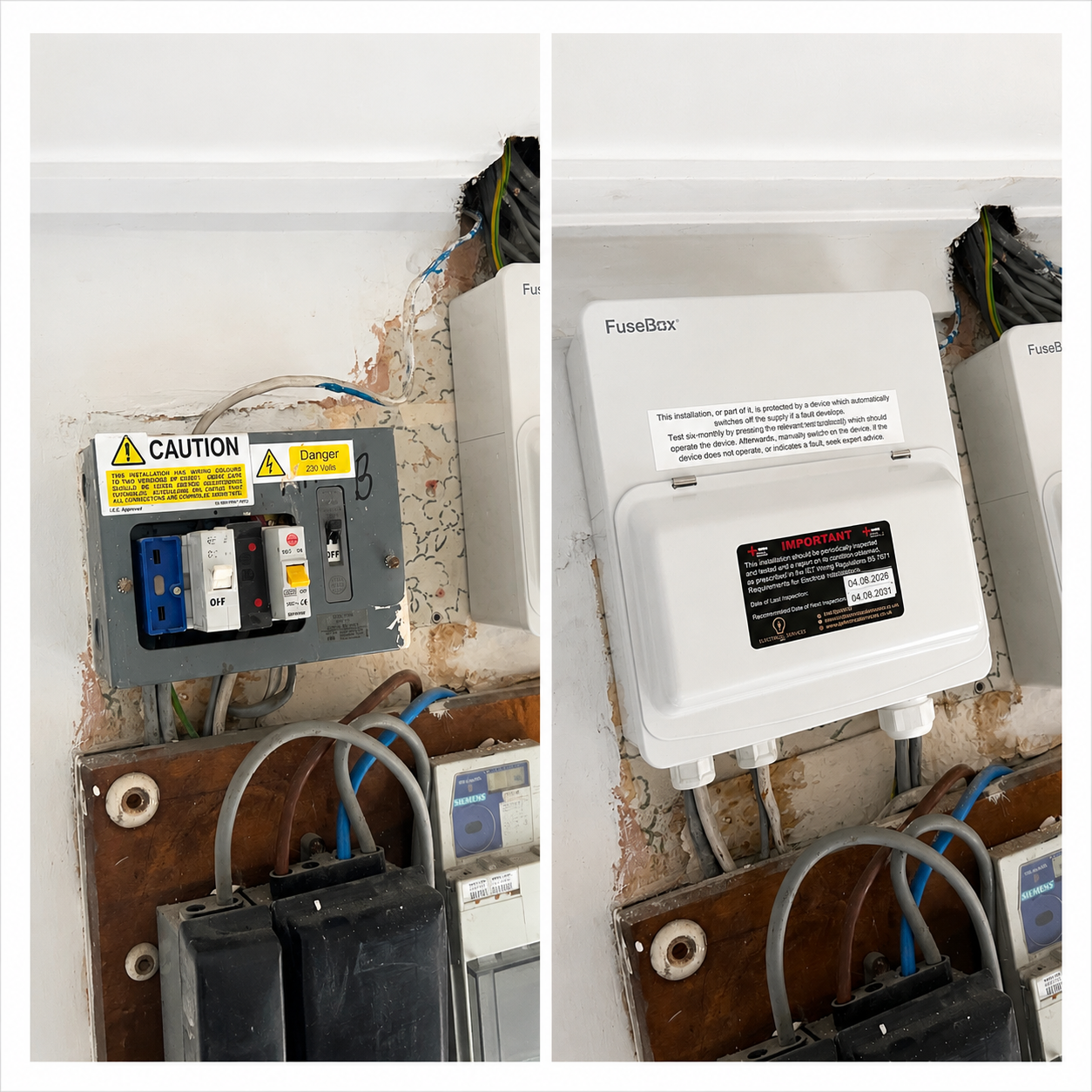
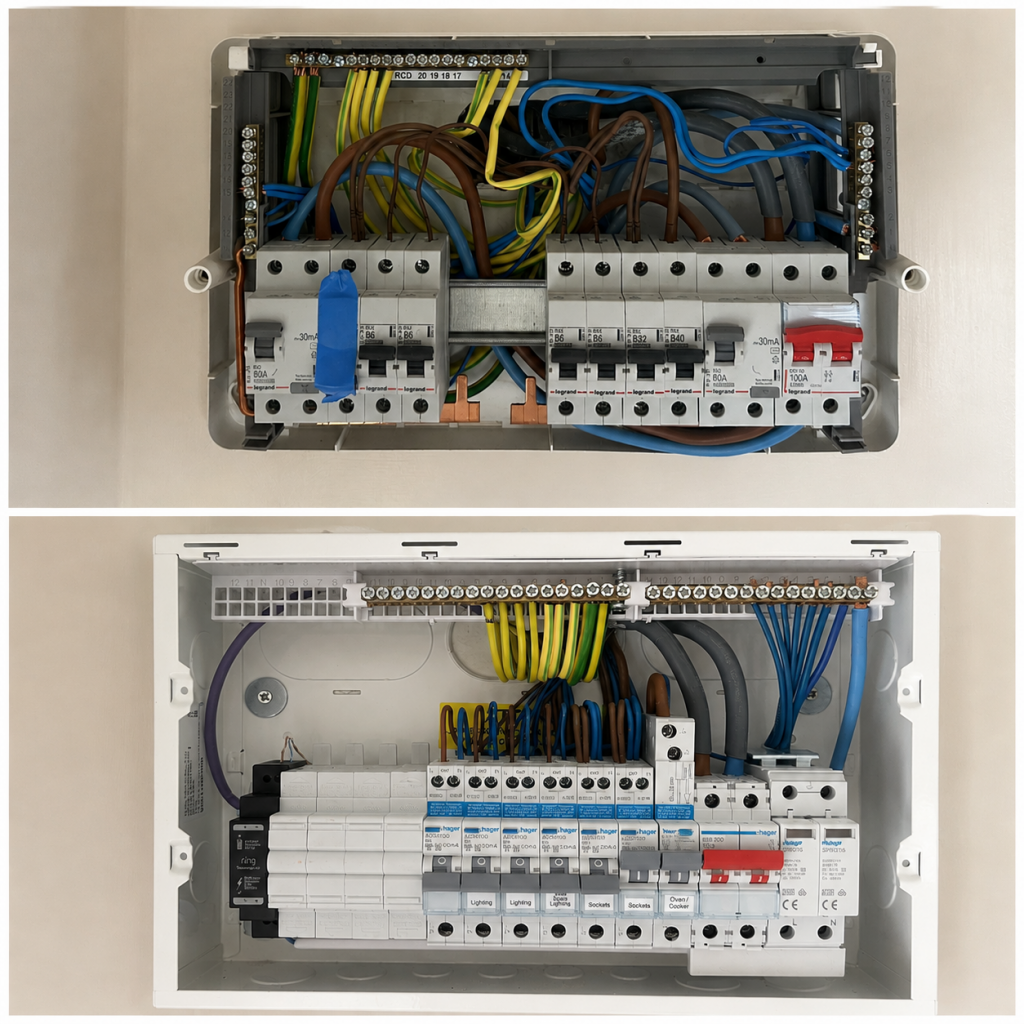
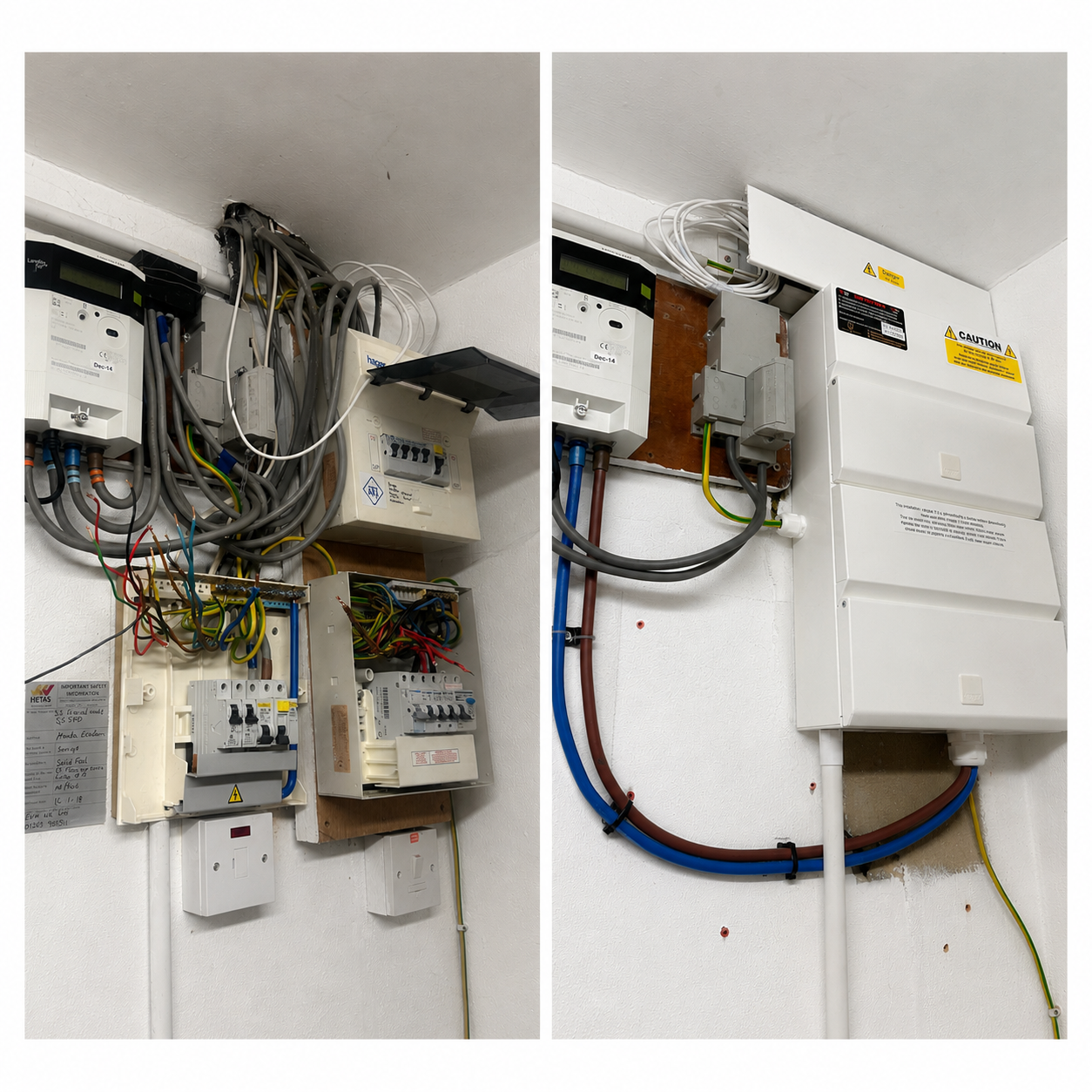
Consumer Unit Upgrades – Before & After
Consumer Unit Replacement FAQs
What’s the difference between a fuse box and a consumer unit?
A fuse box and a consumer unit perform the same basic job: distributing electricity around your home and protecting the circuits. Older fuse boxes typically use replaceable or rewireable fuses, while modern consumer units use resettable protective devices such as circuit breakers and RCBOs, together with additional protection against electric shock, surges and other electrical faults.
What is an RCBO?
An RCBO combines two types of protection in one device: protection against overloads and short circuits, plus residual-current protection against earth leakage and electric shock. Using an RCBO for each circuit also means that a fault can disconnect the affected circuit without unnecessarily switching off several other circuits in the property.
What is surge protection (SPD)?
A Surge Protective Device helps protect the electrical installation and sensitive electronic equipment from short-duration voltage surges. These surges can be caused by events such as lightning or electrical switching and can damage equipment immediately or shorten its life over time. Modern homes contain increasing amounts of sensitive electronics, including boilers, appliances, computers, EV charging equipment and heat-pump controls.
What is an AFDD?
An Arc Fault Detection Device monitors a circuit for the electrical characteristics associated with dangerous arcing, which can occur because of damaged cables, loose connections or worn electrical equipment. If a dangerous arc is detected, the AFDD disconnects the affected circuit to help reduce the risk of fire. Under the current BS 7671 requirements, AFDDs are mandatory on specified socket circuits in certain building types such as HMOs, care homes, high-rise residential buildings and purpose-built student accommodation; they are not automatically required on every circuit in every ordinary home.
Why are new consumer units metal?
New consumer units installed in homes are normally steel because BS 7671 requires the consumer-unit enclosure to be made from non-combustible material, or otherwise enclosed within a suitable non-combustible enclosure. The purpose is to help contain a fire originating inside the consumer unit and prevent the enclosure itself from contributing fuel to the fire. An existing plastic consumer unit does not automatically need replacing simply because it is plastic — its condition and the electrical installation need to be assessed. Plastic cinsumer units are no longer allowed in escape routes like hallways, entrances, cupboards under the stairs.
Do I need a full rewire when changing my consumer unit?
Yes, in many homes the consumer unit can be replaced without a full rewire. The existing wiring must be suitable for continued use and any relevant defects identified beforehand need to be dealt with, but fitting a new consumer unit does not automatically mean all of the cables in the property need replacing. This is also one of the recurring questions on current UK consumer-unit replacement search pages.